JillLebofsky may earn a commission if you buy through links on this page, at no extra cost to you. That does not change what we report.
Part of our DentaVive overview. Last checked October 28, 2026.
DentaVive ingredients are five probiotic strains plus tricalcium phosphate and inulin, and the vendor gives an amount for none of them[1]. That is 0 of 7 ingredients with a disclosed dose.
The probiotics are Lactobacillus reuteri, Lactobacillus paracasei, Bifidobacterium lactis BL-04, Lactobacillus salivarius and Streptococcus salivarius K12. Without a CFU count, nobody can say whether one chewable matches the doses used in studies.
DentaVive ingredients at a glance
All seven DentaVive ingredients appear on the vendor's home page as names only, with no Supplement Facts panel[1]. The table shows what each is for, according to the vendor or its usual role, and our evidence grade for oral health.
| Ingredient | Role claimed | Amount disclosed? | Evidence grade |
|---|---|---|---|
| Lactobacillus reuteri | Gum health | No (strain unnamed) | Limited |
| Lactobacillus paracasei | Oral bacteria balance | No (strain unnamed) | Limited |
| Bifidobacterium lactis BL-04 | Gum health | No | Limited (other strains only) |
| Lactobacillus salivarius | Gums, breath | No (strain unnamed) | Limited |
| Streptococcus salivarius K12 | Breath | No | Limited |
| Tricalcium phosphate | "Remineralization", per vendor | No | Weak |
| Inulin | Prebiotic fiber | No | No oral benefit shown |
What is in each ingredient, and what does research say?
Each strain has a few small human trials at stated doses in other products, and the results are mixed. Oral probiotic effects depend on the exact strain, and DentaVive names the strain for only two of its five probiotics.
Lactobacillus reuteri
The most studied oral probiotic. In a trial of 30 people with periodontitis, lozenges taken twice daily for 12 weeks after a dentist's deep cleaning gave more pocket reduction in moderate and deep pockets[2]. In 45 pregnant women, lozenges lowered gum and plaque scores vs placebo[3].
A 2024 review of 11 trials called the evidence "limited"[4]. Studies used at least 10^8 CFU of each of two named strains, two lozenges a day. DentaVive dose: undisclosed. Grade: Limited.
Lactobacillus paracasei
The positive data are for strain SD1 in milk. In 124 children aged 1.5 to 5, daily SD1 milk for 3 months meant fewer new cavities than standard milk[5]. An adult tablet trial with strain GMNL-33 found no difference from placebo in cavity bacteria[6].
No gum disease trial of this species alone was found. DentaVive dose: undisclosed. Grade: Limited.
Bifidobacterium lactis BL-04
We found no oral-health trial of BL-04. The gum data belong to a different strain, HN019: about 10^9 CFU lozenges twice daily after scaling gave more pocket reduction in 41 people[7], and less gum bleeding vs placebo in 60 people with gingivitis[8]. Those results do not transfer to BL-04. Grade: Limited (other strains).
Lactobacillus salivarius
Most oral data come from strain WB21. In 66 adults, WB21 tablets at 6.7 x 10^8 CFU three times a day with xylitol beat xylitol alone only in smokers[9]. A 30-day SGL03 trial in 51 people found no difference from placebo[10]. DentaVive names no strain. Grade: Limited.
Streptococcus salivarius K12
A native mouth strain sold for breath. In a 30-day trial of 28 people with tongue-coating bad breath, K12 tablets did not beat placebo between groups[11]. The gum and cavity data people quote are for a sister strain, M18, not K12. Studied dose: about 10^9 CFU lozenges, 1 to 2 a day. Grade: Limited.
Tricalcium phosphate
A common calcium source and flow agent in tablets. The vendor says it promotes "natural remineralization"[1]. We found no human trial of swallowed tricalcium phosphate for enamel; the only dental trial used it inside a fluoride varnish painted on teeth[12]. Grade: Weak.
Inulin
A plant fiber that feeds gut bacteria. In a 10-day trial of 45 people, L. salivarius gum with or without 1 g of inulin showed no difference between groups for bad breath[13]. Amount in DentaVive: undisclosed.
How transparent is the DentaVive formula?
Not transparent. DentaVive publishes no Supplement Facts panel, so there is not even a total blend weight to divide among the ingredients. The vendor's /label and /ingredients addresses load the home page, and no label image appears on the sales pages we read[1][14].
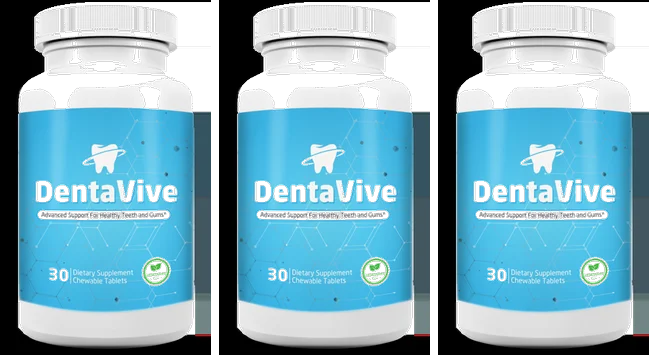
What is known: 30 chewable tablets per bottle, sold as a "30 Day Supply", which implies one a day, and a "Vegan-Friendly Plant-Based Formula". There are no directions, serving size, storage or allergen statement.
If another website lists CFU counts or milligrams for DentaVive, those numbers did not come from the vendor's pages as of October 28, 2026. The vendor's own label, when one appears on your bottle, is the only source to trust.
Ingredient safety and interactions
Probiotics are usually well tolerated, with mild gas or bloating. NCCIH notes rare serious infections in people who are severely ill or have a weakened immune system[15], so ask a doctor first if you take immune-suppressing drugs, are in chemotherapy, had recent surgery or are pregnant.
Antibiotics taken at the same time may kill the strains. Calcium can reduce absorption of some antibiotics, levothyroxine and bisphosphonates[16], though the amount in DentaVive is unknown. Details are on our DentaVive side effects page.
Do these ingredients prove DentaVive works?
No. Ingredient trials tested other strains or other doses, mostly as lozenges or milk, and often alongside professional cleaning. DentaVive itself has no trial, and its missing doses block any comparison.
The vendor's claims about undoing gum disease and replacing root canals, crowns and implants[1] are not supported by any study of the product. Bleeding gums or loose teeth need a dentist. The full evidence breakdown is in does DentaVive work, and prices are on our DentaVive price page.
Back to the DentaVive overview.
Frequently asked questions
What strains are in DentaVive?
The vendor lists Lactobacillus reuteri, Lactobacillus paracasei, Bifidobacterium lactis BL-04, Lactobacillus salivarius and Streptococcus salivarius K12. Only BL-04 and K12 are named to strain level. Tricalcium phosphate and inulin are the other two listed ingredients.
Does DentaVive have a Supplement Facts label?
Not on the vendor site as of October 28, 2026. The sales pages name seven ingredients with no amounts, no CFU count, no other ingredients and no allergen statement. Check the bottle itself if you buy, and keep it for your doctor.
Is DentaVive vegan?
The vendor calls it a Vegan-Friendly Plant-Based Formula. With no full ingredient list or allergen statement published, we could not verify what binders, sweeteners or flavors the chewable tablet contains, so people with allergies should ask the seller first.
Does DentaVive contain fluoride or xylitol?
Neither appears in the seven ingredients the vendor names. Because no complete label is published, we cannot rule out other unlisted ingredients. Keep using fluoride toothpaste, which the ADA and CDC support for cavity protection.
Is K12 in DentaVive good for bad breath?
Evidence is weak. In a 30-day trial of 28 people, K12 tablets did not beat placebo between groups, and a meta-analysis called halitosis evidence insufficient. DentaVive also gives no K12 dose, so no comparison is possible.
Sources
- DentaVive home page (ingredient list, claims). denta-vive.com, read October 28, 2026.
- Teughels et al. 2013, L. reuteri lozenges after full-mouth disinfection, RCT. PubMed, read October 28, 2026.
- Schlagenhauf et al. 2016, L. reuteri lozenges and pregnancy gingivitis, RCT. PubMed, read October 28, 2026.
- Ram et al. 2024, L. reuteri in periodontitis, systematic review of 11 RCTs. PubMed, read October 28, 2026.
- Pahumunto et al. 2018, L. paracasei SD1 milk and caries in children, RCT. PubMed, read October 28, 2026.
- Chuang et al. 2011, L. paracasei GMNL-33 tablets and oral bacteria, RCT. PubMed, read October 28, 2026.
- Invernici et al. 2018, B. lactis HN019 after scaling and root planing, RCT. PubMed, read October 28, 2026.
- Furlaneto et al. 2024, B. lactis HN019 in gingivitis, RCT. PubMed, read October 28, 2026.
- Shimauchi et al. 2008, L. salivarius WB21 tablets and periodontal health, RCT. PubMed, read October 28, 2026.
- L. salivarius SGL03 in periodontitis maintenance, placebo-controlled trial. PubMed, read October 28, 2026.
- He et al. 2020, S. salivarius K12 for halitosis, RCT. PubMed, read October 28, 2026.
- Chen et al. 2021, silver nitrate and fluoride varnish with functionalized TCP in young children, RCT. PubMed, read October 28, 2026.
- L. salivarius G60 gum with or without inulin for halitosis, RCT. PubMed, read October 28, 2026.
- DentaVive sales video page. denta-vive.com, read October 28, 2026.
- Probiotics: What You Need To Know. NCCIH, NIH, read October 28, 2026.
- Calcium: Fact Sheet for Health Professionals. NIH Office of Dietary Supplements, read October 28, 2026.
This page is general information, not medical advice. Dietary supplements are not reviewed by the FDA for safety or effectiveness before they are sold and are not intended to diagnose, treat, cure or prevent any disease. Talk to your doctor before taking any supplement, especially if you are pregnant, nursing, take medication or have a health condition.