JillLebofsky may earn a commission if you buy through links on this page, at no extra cost to you. That does not change what we report.
Part of our DentaVive overview. Last checked October 28, 2026.
Does DentaVive work? Nobody can say, because no study has tested the DentaVive chewable itself and the vendor publishes no CFU count or amount for any of its five probiotic strains.
Related strains have small human trials for gums and breath. A 2024 systematic review of 11 trials of one of them, L. reuteri, found only "limited evidence" for gum benefits[6]. That is far short of what the sales page promises.
Does DentaVive work? The short answer
DentaVive has not been shown to work. The finished product has no published trial, and its label hides every dose. The vendor says the tablets stop bleeding gums, strengthen loose teeth and do away with root canals, crowns and implants[1]. No study of DentaVive supports any of those claims.
What can be said is narrower. Some strains in the formula, given at stated doses in other products, produced small changes in plaque, gum bleeding or pocket depth in short trials, often as an add-on to a cleaning by a dentist[4][8]. Other trials of the same species found no difference from placebo[3][9].
Because DentaVive names no strain ID for three of its five probiotics and gives no CFU count, you cannot check whether one tablet a day matches any of those study doses.
Which evidence levels should you not confuse?
Four levels of evidence get blurred together on supplement sales pages. Only the top level, a trial of the finished product, would tell you whether DentaVive works, and that level is empty.
Plausibility
Probiotics for the mouth make sense on paper: friendly bacteria may crowd out harmful ones. A good idea is a starting point, and it proves nothing about a product.
Ingredient trials
These test one strain at a known dose, usually as a lozenge, milk or gum. Examples are L. reuteri lozenges in periodontitis[4] and B. lactis HN019 lozenges after scaling[8]. Results apply to that strain and dose only.
Finished-product trial
This would test DentaVive tablets against placebo in people with gum problems. We found none, and the vendor names none.
Replication
A result counts more when other teams repeat it. Here replication is weak: a meta-analysis of L. reuteri for gingivitis found no significant pooled effect[7], and most L. salivarius oral data come from one strain and one research group[2].
DentaVive claims vs what the evidence supports
The table sets the vendor's main claims[1] against what the strain research can reasonably support. None of the claims has a DentaVive trial behind it.
| Vendor claim | Reasonable reading | Limitation |
|---|---|---|
| "Stops bleeding gums in days" | HN019 lozenges cut gum bleeding vs placebo over 8 weeks in 60 people with gingivitis[12] | Different strain, stated dose, weeks not days; DentaVive dose unknown |
| Undoes gum disease "naturally" | In periodontitis trials, probiotics helped a little when added to a dentist's deep cleaning | No trial used a probiotic in place of dental care |
| "Strengthens loose teeth" | No trial we found measured loose teeth or tooth loss | No support |
| Replaces root canals, crowns and implants | No reasonable reading: these repair structural damage | Acting on this claim can delay needed dental work |
| Tricalcium phosphate aids remineralization | Only a topical varnish trial exists, driven by fluoride and silver | No trial of swallowed tricalcium phosphate for teeth |
| "Rated 4.9 by 17,000 Reviews" | A vendor figure with no platform named | Cannot be checked |
For the full list of claims and how the vendor's pages contradict each other, see our DentaVive legitimacy check.
Which ingredients matter most?
The probiotic strains matter most, and every one of them has a dose, form or population mismatch with its research. Oral probiotic effects are strain-specific, so a species name alone does not carry over a trial result.
- L. reuteri: trials used lozenges with at least 10^8 CFU of each of two named strains, twice a day[5]. DentaVive names no strain.
- L. salivarius: WB21 tablets gave 6.7 x 10^8 CFU three times a day with xylitol; a gum benefit over control showed up only in smokers[2]. DentaVive names no strain.
- B. lactis BL-04: no oral-health trial found. The gum data are for HN019, about 10^9 CFU per lozenge twice daily after scaling[8].
- S. salivarius K12: a 30-day bad-breath trial showed no difference from placebo between groups[9].
- L. paracasei: the positive data are for SD1 in milk given to children aged 1.5 to 5, for cavities, not gums[10].
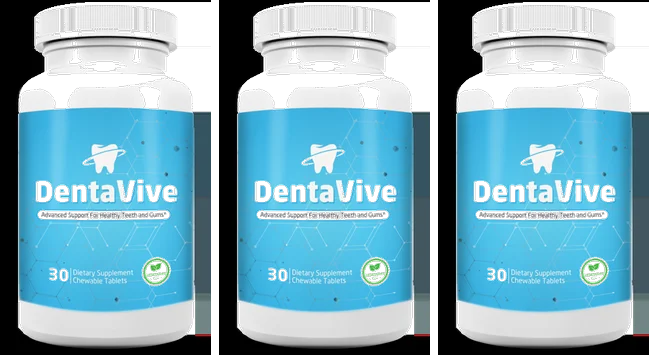
DentaVive is one chewable a day, implied by its "30 Day Supply" bottle, with amounts unknown. Strain by strain detail is on our DentaVive ingredients page.
What results are realistic to expect?
If anything, small changes in plaque or gum bleeding scores over 4 to 12 weeks, and only if the strains and doses resemble the trials, which nobody can confirm. That is what the studies measured.
Pocket-depth changes were tiny. In one L. salivarius trial, depth fell from 2.50 to 2.42 mm and did not differ from placebo[3]. In the larger L. reuteri trials, gains came after a dentist's deep cleaning[4]. No study in our evidence files measured tooth loss, loose teeth or avoided dental work.
When should you see a doctor instead?
Bleeding gums, loose teeth and tooth pain are signs to book a dentist, whatever supplement you take. See a dentist or doctor right away if you have:
- Gums that bleed every time you brush for more than two weeks
- A tooth that feels loose or has shifted
- Swelling in the gums, face or jaw, or a pus-filled bump
- Fever with mouth pain or swelling
- Toothache that wakes you or lasts more than a day or two
- A sore in the mouth that has not healed in two weeks
Keep brushing, flossing and fluoride toothpaste. The vendor's references frame fluoride as harmful to oral bacteria; the ADA and CDC support fluoride for cavity protection.
Evidence conclusion
DentaVive's claims are not backed by any test of the product, and the missing label blocks any dose check. The table gives our assessment as of October 28, 2026.
| Decision question | Current assessment |
|---|---|
| Has DentaVive itself been tested? | No published trial found or named by the vendor |
| Can its dose be compared to studies? | No: no CFU count or amounts disclosed |
| Do the strains have human data? | Yes, small and mixed; graded Limited for all five |
| Can it replace dental work? | No study supports this; see a dentist |
| Is it safe for everyone? | Probiotics need care in immune-compromised people[11]; see DentaVive side effects |
Read how we check products for our method.
Back to the DentaVive overview.
Frequently asked questions
Is there a clinical study on DentaVive?
No. We found no published trial of the DentaVive chewable, and the vendor names none. The studies that exist tested single probiotic strains at stated doses in other products, mostly lozenges, so their results cannot be transferred to DentaVive.
How long does DentaVive take to work?
No timeframe has been tested for DentaVive. Strain trials in other products measured plaque and gum bleeding over 4 to 12 weeks, with small effects. The vendor claim of results in days has no study behind it.
Can DentaVive replace a root canal or implant?
No study supports that. The vendor says DentaVive removes the need for root canals, crowns and implants, but those procedures repair structural damage no probiotic can rebuild. A dentist should assess any painful, cracked or loose tooth.
Can DentaVive fix bleeding gums?
Not shown. One different B. lactis strain reduced gum bleeding vs placebo over 8 weeks in a small trial. DentaVive discloses no doses and has no trial. Gums that keep bleeding for two weeks need a dental exam.
How many CFU are in DentaVive?
The vendor does not say. No Supplement Facts panel, CFU count or strain amounts were published as of October 28, 2026, so the dose in one chewable cannot be compared with the doses used in any study.
Sources
- DentaVive home page (benefit claims, strain list). denta-vive.com, read October 28, 2026.
- Shimauchi et al. 2008, L. salivarius WB21 tablets and periodontal health, RCT. PubMed, read October 28, 2026.
- L. salivarius SGL03 in periodontitis maintenance, placebo-controlled trial. PubMed, read October 28, 2026.
- Teughels et al. 2013, L. reuteri lozenges after full-mouth disinfection, RCT. PubMed, read October 28, 2026.
- Schlagenhauf et al. 2016, L. reuteri lozenges and pregnancy gingivitis, RCT. PubMed, read October 28, 2026.
- Ram et al. 2024, L. reuteri in periodontitis, systematic review of 11 RCTs. PubMed, read October 28, 2026.
- Akram et al. 2020, L. reuteri for gingivitis, meta-analysis. PubMed, read October 28, 2026.
- Invernici et al. 2018, B. lactis HN019 after scaling and root planing, RCT. PubMed, read October 28, 2026.
- He et al. 2020, S. salivarius K12 for halitosis, RCT. PubMed, read October 28, 2026.
- Pahumunto et al. 2018, L. paracasei SD1 milk and caries in children, RCT. PubMed, read October 28, 2026.
- Probiotics: What You Need To Know. NCCIH, NIH, read October 28, 2026.
- Furlaneto et al. 2024, B. lactis HN019 in gingivitis, RCT. PubMed, read October 28, 2026.
This page is general information, not medical advice. Dietary supplements are not reviewed by the FDA for safety or effectiveness before they are sold and are not intended to diagnose, treat, cure or prevent any disease. Talk to your doctor before taking any supplement, especially if you are pregnant, nursing, take medication or have a health condition.